In the world of currency trading, understanding the concept of trade quantities is essential. A standardized unit, known as a lot, determines how much currency is bought or sold in a single transaction. This system helps traders manage their exposure effectively.
Lots come in various categories, including standard, mini, micro, and nano. Each type offers different levels of exposure. For instance, a standard lot consists of 100,000 base currency units. This framework is crucial because currency prices often fluctuate in small increments called pips, making individual unit transactions impractical.
This article will delve into why standardized trade quantities are vital. Readers will learn how lot sizes relate to pip movements, account exposure, and leverage. Furthermore, it will highlight the importance of sizing trades as a risk-management strategy rather than merely a means to enhance potential profits.
By the end, readers will be equipped to calculate an appropriate trade size based on their account balance, risk percentage, stop-loss distance, and pip value.
What Forex Lot Sizes Mean in a Trade
To succeed in currency trading, one must comprehend trade quantities. A lot is a standardized unit representing the amount of currency bought or sold in a single transaction. Understanding this concept is crucial for effective trading.
Position size is determined by the lot size and the number of lots involved. For instance, one position may contain fractions of a standard lot, such as 0.1 lots for a mini lot or 0.01 lots for a micro lot. This flexibility allows traders to adjust their exposure based on their strategy.
Moreover, doubling the lot size generally doubles both the potential profit and potential loss from the same market movement. It’s essential to recognize that the notional trade amount may differ from the smaller deposit required when leverage is available.
Improper position sizing is a significant reason many retail traders face rapid account losses. By understanding how lot sizes affect trading, traders can make more informed decisions.
Forex Lot Sizes: Compare Standard, Mini, Micro, and Nano
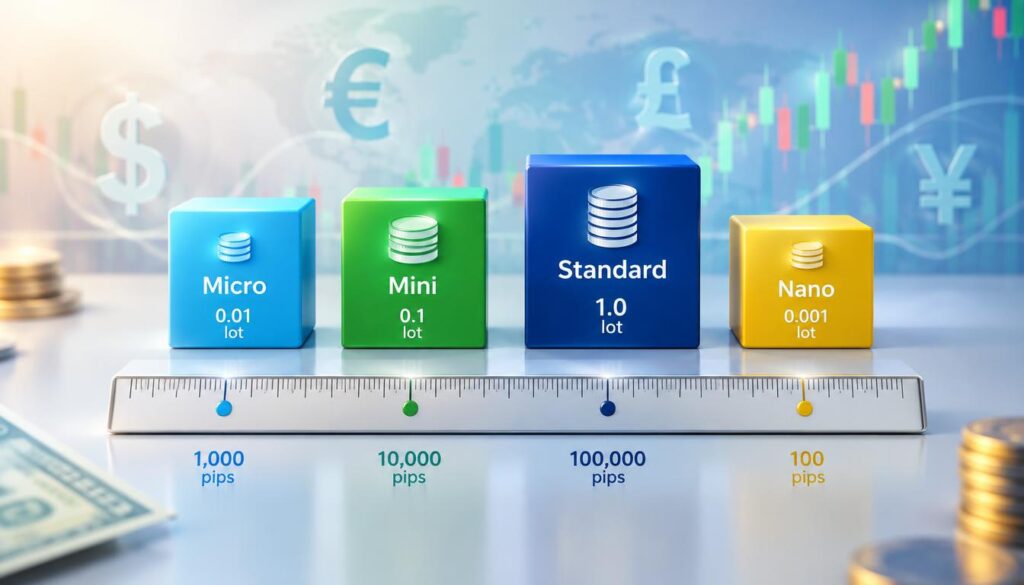
Grasping the various trade quantities is vital for effective participation in currency markets. There are four main categories of trade quantities: standard, mini, micro, and nano. Each serves a unique purpose and suits different trading strategies.
Standard Lots: 100,000 Base Currency Units
A standard lot, represented as 1.0, equals 100,000 units of the base currency. This size is typically associated with larger or institutional-style positions. Traders using standard lots often have significant capital at stake.
Mini Lots: 10,000 Base Currency Units
A mini lot, represented as 0.1, consists of 10,000 base currency units. This size allows traders to take positions that are one-tenth of a standard lot, providing more flexibility for managing risk.
Micro Lots: 1,000 Base Currency Units
Micro lots, indicated as 0.01, represent 1,000 base currency units. They can yield a typical pip value of $0.10 on major USD-quoted pairs, making them ideal for those testing strategies or trading with smaller accounts.
Nano Lots: 100 Base Currency Units
Nano lots, denoted as 0.001, equal 100 base currency units. This size is useful for traders looking to minimize risk further, with a typical EUR/USD pip value of $0.01. Reducing the contract size from 100,000 units to 100 units drastically lowers the financial impact of each pip.
How Base and Quote Currency Affect Position Size

Understanding the interplay between base and quote currencies is crucial for effective trading. In the EUR/USD currency pair, the euro is the base currency, while the U.S. dollar serves as the quote currency. This relationship is vital for determining how much value a position holds.
For example, at an exchange rate of 1.3000, one euro exchanges for $1.3000. Consequently, a standard lot, which contains 100,000 euros, has a quoted value of $130,000. Similarly, a mini lot, comprising 10,000 euros, is valued at $13,000.
When traders buy EUR/USD, they express a belief that the euro will strengthen against the dollar. Conversely, selling indicates an expectation that the euro will weaken. Understanding these dynamics helps traders make informed decisions regarding their positions.
| Lot Size | Base Currency (EUR) | Quoted Value (USD) |
|---|---|---|
| Standard Lot | 100,000 | $130,000 |
| Mini Lot | 10,000 | $13,000 |
| Micro Lot | 1,000 | $1,300 |
| Nano Lot | 100 | $130 |
How Lot Size Changes Pip Value, Exposure, and Potential Loss

Understanding how different contract sizes impact pip value is crucial for traders. On the EUR/USD pair, the pip values vary significantly based on the contract size.
A standard lot typically has a pip value of $10. This means that a 10-pip movement on one standard lot results in a $100 change in value. In contrast, a mini lot has a pip value of $1, while a micro lot is valued at $0.10.
For example, a 10-pip favorable movement on a micro lot yields only about $1. This illustrates how smaller contracts can reduce absolute account volatility.
It’s important to note that larger contracts amplify both favorable and unfavorable price changes. Therefore, understanding the distinction between pip value and total position value is essential for effective risk management.
How to Calculate Lot Size Based on Account Risk
Calculating the appropriate trade size is essential for managing risk effectively. Traders can utilize a straightforward formula to determine the right lot size based on their account balance and risk tolerance.
The formula is as follows:
Lot Size = (Account Balance × Risk Percentage) ÷ (Stop Loss in Pips × Pip Value)
For example, consider a trader with a $10,000 account who is willing to risk 1% on a trade with a 50-pip stop on the EUR/USD pair. The calculation would yield a position size of 0.2 lots. Similarly, a trader with a $500 account risking 1% with a 50-pip stop would require one micro lot.
Another example involves a $20,000 account risking 2% with an 80-pip stop on GBP/JPY, resulting in approximately 0.54 lots at a pip value of $9.30.
It’s crucial to check pip values for the specific currency pair being traded. USD-quoted pairs often have straightforward pip values, while USD-base and cross pairs may require conversion based on the current exchange rate.
| Account Size | Risk % | Stop Loss (Pips) | Pip Value | Calculated Lot Size |
|---|---|---|---|---|
| $10,000 | 1% | 50 | $10 | 0.2 |
| $500 | 1% | 50 | $0.10 | 1.0 |
| $20,000 | 2% | 80 | $9.30 | 0.54 |
Choose a Lot Size That Fits the Account and Trading Plan

Selecting the right trade quantity is crucial for aligning with one’s trading strategy and account balance. For beginners, it is advisable to start small when learning or testing a strategy. Using micro or nano contracts allows new traders to experience live price movements without risking significant capital.
A $1,000 account typically risks only $10 to $20 at a 1-2% risk range. Oversized contracts can lead to unnecessary losses, especially when margins appear available. For example, a 100-pip stop requires half the position size of a 50-pip stop for the same dollar risk.
Traders should first select a technically valid stop and then calculate the appropriate trade size. If the resulting position feels too small to justify the trade, the disciplined choice is to wait for a better setup or gradually build the account.
| Account Size | Risk % | Max Risk per Trade | Recommended Lot Size |
|---|---|---|---|
| $1,000 | 1% | $10 | Micro |
| $5,000 | 1% | $50 | Mini |
| $10,000 | 1-2% | $100-$200 | Standard |
How Leverage and Margin Affect Forex Trade Size

Understanding how leverage and margin influence trade sizes is essential for effective trading. Leverage allows traders to control a larger position while only depositing a fraction of its total value. For instance, a EUR/USD position worth $108,500 may require approximately $2,170 of margin at 50:1 leverage.
However, it’s crucial to note that the trader remains exposed to the full position. A 1% adverse move on this $108,500 position could result in a loss of $1,085 before accounting for transaction costs. This example illustrates the risks associated with high leverage.
Available margin indicates what a broker permits, but it doesn’t reflect what an account can safely handle. Leverage amplifies both gains and losses, meaning traders can face losses that exceed their initial deposit.
| Leverage | Position Value | Required Margin | 1% Adverse Move Loss |
|---|---|---|---|
| 50:1 | $108,500 | $2,170 | $1,085 |
| 100:1 | $108,500 | $1,085 | $1,085 |
| 200:1 | $108,500 | $542.50 | $1,085 |
Lot-Sizing Mistakes That Can Increase Trading Risk
Recognizing common mistakes in trade sizing can significantly impact a trader’s performance. Many traders fall into the trap of using the same position size for every trade. For example, trading a consistent 0.1 lot with varying stop distances, such as 20 to 100 pips, leads to different risk exposures.
Additionally, increasing position size after a win or loss can be detrimental. This practice may transform a standard drawdown into rapid account depletion. It’s essential to maintain discipline and stick to a predefined risk strategy.
Moreover, ignoring correlated positions can amplify risk. For instance, taking 1% risk on EUR/USD, GBP/USD, and AUD/USD can result in approximately 3% combined exposure when these pairs move in tandem. This interconnectedness should be considered when managing trades.
Finally, traders should account for slippage, especially during volatile news events. A buffer of 10-20% can help mitigate adverse execution impacts. Remember, ten consecutive 1% losses leave about 90.4% of the original account, while ten 5% losses reduce it to roughly 59.9%.
Build a Consistent Lot-Sizing Routine for Every Trade
Before each trade, confirm the account balance, set a risk limit, choose a valid stop, check pip value, and calculate position size. Record the currency pair, entry price, stop distance, planned loss, execution price, and result. This log helps show whether the approach works over time.
Include spreads, commissions, slippage, broker contract limits, and exposure across correlated positions. Do not let a recent win or loss, round-number contract, or available leverage drive the next decision. Beginners can test a plan with micro contracts; larger positions need suitable equity and proven limits.
For illustration, $5,000 growing by 3% each month would reach about $7,127 after 12 months. This shows compounding, not a promise of profit. The right contract amount keeps a planned loss within the trader’s preset risk limit. Consistency supports sound risk management.