In recent years, the landscape of forex trading has evolved significantly. Many individuals are curious about the legality and accessibility of this market in Thailand. With the rise of the middle class and gradual changes in capital controls, the opportunity for traders has expanded.
While local options exist, most thai traders prefer to open accounts with international brokers. This article will explore the major platforms available, including IG, Interactive Brokers, and others. Each broker will be evaluated based on pricing, platforms, and regulatory compliance.
Additionally, it is crucial to differentiate between standard currency exchanges and leveraged contracts for difference (CFDs). The latter can carry significant risks, as highlighted by disclosures from leading providers.
Understanding the role of the Securities and Exchange Commission of Thailand and the Bank of Thailand is essential before funding any accounts. This article will guide you through these aspects, ensuring a comprehensive understanding of the market.
Is forex trading in Thailand legal for retail traders?
The legality of engaging in foreign exchange activities is a crucial concern for many individuals. For Thai residents, forex trading is indeed legal, but it comes with specific restrictions. Notably, these regulations involve transactions in the Thai baht and certain foreign-exchange operations.
While Thai traders can access various currency pairs and contracts through international brokers, it’s important to note that the SEC of Thailand does not issue local retail licenses for forex or CFD brokers. This means that although trading is legal, not every broker is locally licensed.
Additionally, the treatment of CFDs differs from spot-style forex trading. The leverage associated with CFDs can lead to rapid losses, with disclosures indicating that over 70% of retail accounts may incur losses. Therefore, understanding these risks is essential for all traders.
Lastly, the Bank of Thailand oversees relevant foreign-exchange and outbound-transfer regulations. It is advisable for residents to confirm whether an international broker accepts Thai clients before proceeding with an account application.
| Aspect | Details |
|---|---|
| Legal Status | Legal for Thai residents |
| Broker Licensing | No local retail licenses issued |
| Daily Deposit Limit | Up to $50,000 USD |
| Risk with CFDs | Over 70% of retail accounts incur losses |
What the Securities and Exchange Commission of Thailand regulates
Effective regulation of the securities market ensures investor protection and market integrity. The Securities and Exchange Commission of Thailand (SEC) is the primary authority overseeing this area. It supervises securities markets, listed companies, and capital-market intermediaries.
The legal foundation for the SEC’s responsibilities is established in the Securities and Exchange Act B.E. 2535 (1992). This act outlines the SEC’s role in maintaining a fair and transparent market.
Traders should always check the SEC register for warnings or authorizations regarding local entities. This step can help identify whether a broker is compliant with regulations. It is important to note that just because a broker is involved in the market does not mean it is licensed by the SEC.
Investors are encouraged to compare the broker’s stated legal entity with official records before opening an account. This diligence can help avoid potential issues with unregulated entities.
How the Bank of Thailand oversees foreign exchange and offshore transfers
The oversight of foreign exchange by Thailand’s central bank impacts how residents engage with international brokers. Understanding these regulations is vital for anyone looking to manage their finances effectively.
The Bank of Thailand regulates foreign-exchange transactions and capital controls. Thai residents must verify daily and annual transfer rules before sending money to offshore brokerage accounts. This ensures compliance and helps avoid unexpected issues.
For instance, the daily deposit limit is set at $50,000 USD, but it’s crucial to confirm this against current bank procedures. Additionally, converting Thai baht into USD or EUR can lead to extra costs, even if a broker advertises low trading fees.
Traders should consult both their bank and broker about documentation, transfer purposes, currency conversion, and any receiving-bank charges. This diligence can prevent costly mistakes.
| Consideration | Details |
|---|---|
| Daily Deposit Limit | $50,000 USD |
| Annual Investment Limits | Varies by broker |
| Currency Conversion Costs | May apply when using USD or EUR accounts |
| Verification Steps | Check with bank and broker |
Best forex brokers in Thailand for 2026: top picks at a glance
In the dynamic realm of investments, choosing the right broker is crucial. For Thai traders, several options stand out in 2026. These brokers offer a range of features tailored to meet the needs of both new and experienced investors.
IG for broad market access and established international regulation
IG is renowned for its extensive market access. With an overall score of 5.0/5, it offers a £1 minimum deposit and an average EUR/USD spread of 0.91.
Interactive Brokers for professional, multi-asset trading
Interactive Brokers is ideal for serious traders. It features a $0 minimum deposit and a competitive 0.626 all-in EUR/USD raw-spread cost. Its high Trust Score of 99 adds to its credibility.
Saxo for research and a wide choice of instruments
Saxo excels in research and offers over 70,000 tradable instruments. With a $0 minimum deposit and a 1.0 average EUR/USD spread, it provides a robust platform for investors.
| Broker | Minimum Deposit | Average EUR/USD Spread | Overall Score |
|---|---|---|---|
| IG | £1 | 0.91 | 5.0/5 |
| Interactive Brokers | $0 | 0.626 | 99 Trust Score |
| Saxo | $0 | 1.0 | Varied |
IG review: a strong all-around broker for Thai traders
Choosing the right broker can significantly impact the success of investors. IG stands out as a comprehensive option for those looking to explore diverse markets. With regulatory coverage from 11 Tier-1 jurisdictions, including the FCA and ASIC, it offers peace of mind for users.
Thai traders will appreciate access to over 19,000 global markets, covering forex, shares, indices, and commodities. IG supports various platforms, including its proprietary web platform, the IG Trading app, and MetaTrader 4. This variety allows users to select a platform that best fits their trading style.
When evaluating costs, the EUR/USD spread is competitive at 0.91. It’s essential for traders to confirm the precise legal entity of IG International, along with account currency, leverage, and protections offered during the onboarding process.
| Feature | Details |
|---|---|
| Regulatory Coverage | 11 Tier-1 jurisdictions |
| Market Access | Over 19,000 markets |
| Platforms Supported | IG Trading app, MetaTrader 4, ProRealTime |
| EUR/USD Spread | 0.91 |
Interactive Brokers and Saxo: options for experienced traders
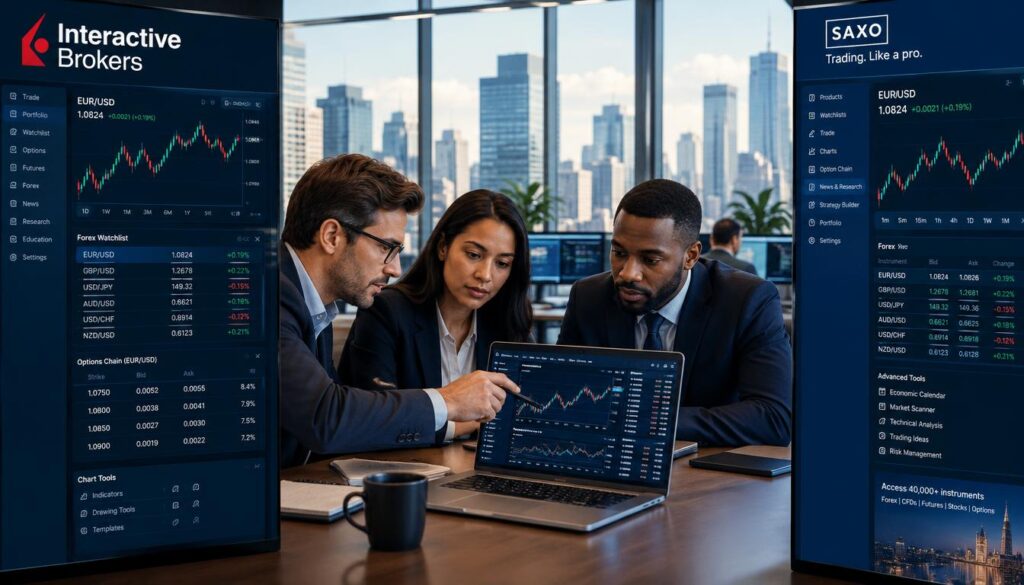
The right trading platform can empower experienced traders to access diverse markets effectively. Two prominent options are Interactive Brokers and Saxo, both offering unique features tailored for seasoned investors.
Interactive Brokers, founded in 1977 and publicly traded on NASDAQ, provides a multi-currency account that includes forex, stocks, options, futures, ETFs, and bonds. Its Trader Workstation is designed for advanced users, offering comprehensive tools for analysis and execution.
Saxo, with over 30 years of experience and headquartered in Denmark, boasts a strong reputation. It offers SaxoTraderGO and SaxoTraderPRO, catering to traders who require robust research and trading capabilities.
When considering minimum deposits, Interactive Brokers has a $0 requirement and charges a $2 minimum commission per trade. Saxo, meanwhile, emphasizes its regulatory strength across seven Tier-1 jurisdictions, appealing to clients seeking security and reliability.
Pepperstone and Fusion Markets: platform choice and pricing
Selecting the right platform can greatly influence the trading experience for investors. For Thai traders, both Pepperstone and Fusion Markets offer unique advantages that cater to different needs.
Pepperstone requires a $10 minimum deposit and supports popular trading platforms like MT4, MT5, and TradingView. It charges a $7 round-turn commission on Razor accounts. This structure appeals to those seeking competitive spreads and familiar interfaces.
On the other hand, Fusion Markets has a $0 minimum deposit and offers a $4.50 round-turn commission on Zero accounts. This can be particularly attractive for traders who want to minimize initial costs.
Both brokers provide access to multiple platforms, ensuring that users can choose what suits them best. However, it’s essential to consider the implications of CFD leverage and crypto availability as separate risks.
More forex brokers to compare in Thailand
Exploring various brokers can help traders make informed decisions. Each broker offers unique features and requirements that can suit different trading styles. Here are some notable options to consider:
FP Markets for platform variety and educational resources
FP Markets requires a $50 or AU$100 minimum deposit. It supports various platforms, including MT4, MT5, cTrader, IRESS, and TradingView. This variety allows traders to choose a platform that fits their needs.
Capital.com for an accessible web and mobile experience
Capital.com is beginner-friendly, with a $20 minimum deposit and an average EUR/USD spread of 0.7. Its proprietary mobile tools enhance accessibility for traders on the go.
FOREX.com, XTB, and Plus500 for distinct platform and product needs
Plus500 requires a €50 minimum deposit and offers over 2,800 CFDs through its WebTrader platform. FOREX.com has a $100 minimum deposit, while XTB has a $0 minimum deposit, providing various options for traders.
Thai residents should remember that brand-level regulation does not guarantee which legal entity will actually hold their account. This understanding is crucial for ensuring compliance and safety.
How to compare forex brokers by spreads, fees, and account terms
Analyzing the financial terms of brokers is crucial for making informed trading decisions. When comparing brokers, it’s essential to look beyond just the quoted spreads. A comprehensive assessment should include:
- Average spreads alongside commissions and overnight financing costs.
- Minimum deposits, withdrawal charges, and inactivity fees.
For instance, FP Markets reports an average EUR/USD spread of 1.17, while Fusion Markets offers a competitive 0.90 on its Classic account. Understanding these differences can help traders choose wisely.
Additionally, consider how a $5 withdrawal fee, like that from BlackBull Markets, can disproportionately impact smaller accounts. Minimum deposits should also be assessed against realistic position sizes, as a low entry requirement does not imply low risk in leveraged trading.
Ultimately, traders should calculate the total round-trip costs across several trades. This approach provides a clearer picture than merely selecting a broker based on headline spreads.
How to verify a broker’s license and client protections

Understanding how to verify a broker’s license is essential for all investors. It is crucial to match the broker’s legal entity with the regulator’s official register. Relying solely on a familiar brand name can lead to potential risks.
Different regulators, such as the FCA, ASIC, and BaFin, offer varying levels of supervision. This can impact aspects like leverage and complaint handling. For example, Fusion Markets operates under multiple entities, which means protections may differ based on the client’s location.
Investors should check for fund segregation, negative balance protection, and available complaint options. These protections are vital at the account level, not just for the brand. Thai residents are advised to save records of regulatory documents, account agreements, and communications before depositing money with an offshore broker.
Trading platforms and instruments available to Thai residents
Understanding the available platforms is essential for those looking to invest wisely. Thai residents have access to a variety of trading platforms that cater to different trading styles and preferences.
Comparing these platforms can help investors find the best fit for their needs. Notable options include:
- MetaTrader 4 and 5: Popular among many traders for their user-friendly interfaces and advanced charting tools.
- TradingView: A web-based platform that offers extensive charting features and social networking for traders.
- Proprietary platforms: Many brokers, like IG, offer their own tools designed for optimal trading experiences.
- Mobile apps: Most brokers provide mobile solutions, allowing traders to manage their accounts on the go.
Access to various instruments is also a significant factor. Thai residents can trade:
- Forex pairs
- CFDs
- Shares and indices
- Commodities
- Crypto products
Choosing the right platform and instruments can greatly enhance the trading experience and lead to more informed decisions.
Depositing and withdrawing money, including Thai baht conversion
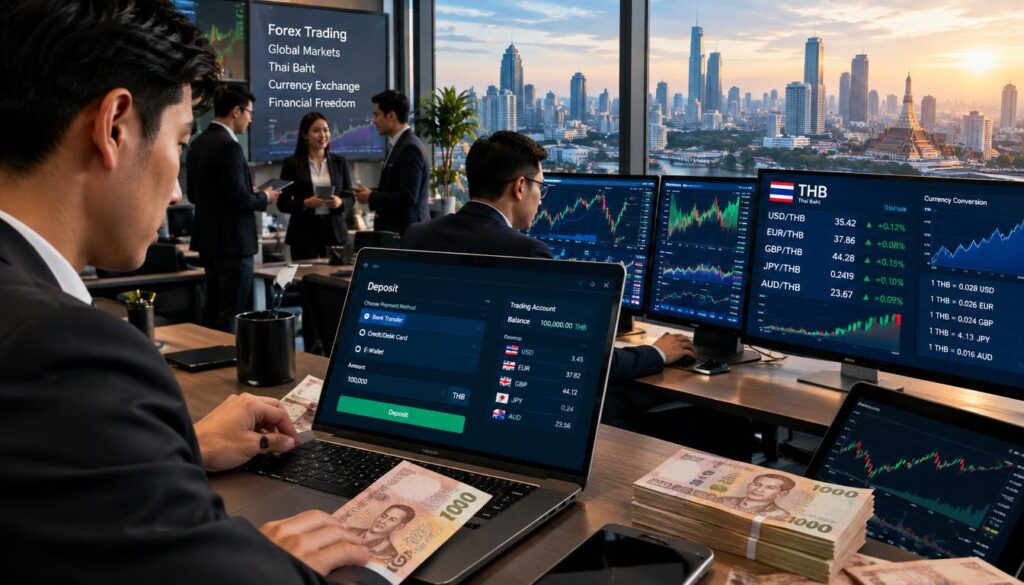
Understanding the methods for depositing and withdrawing funds is vital for effective financial management. Many international brokers do not support Thai baht (THB) accounts directly. Instead, they often require Thai residents to fund accounts in USD or EUR.
When considering currency conversion, it’s important to factor in various costs. These include card spreads, bank charges, broker fees, and potential intermediary-bank deductions. Such costs can add up quickly, impacting overall profitability.
Here are some options for funding accounts:
- Fusion Markets: Accepts Visa, Mastercard, PayPal, Skrill, Neteller, bank wire, and multiple cryptocurrency methods.
- FP Markets: Offers Visa, Mastercard, Neteller, bank transfer, Skrill, PayPal, Apple Pay, and Google Pay.
Before committing substantial money to an offshore broker, traders are encouraged to test a small deposit and withdrawal. This practice helps ensure that the chosen broker meets their needs effectively.
Taxes and offshore-account considerations for Thai residents
Tax implications for Thai residents engaged in foreign-source income can be complex. Those involved in trading should be aware that profits from foreign exchanges may be taxable when remitted into Thailand. The personal income tax rates range from 5% to 35%, depending on total annual income.
It is advisable for traders to consult a qualified Thai tax adviser. This is essential, as the rules regarding foreign income have evolved over time. Each investor’s situation can vary significantly based on residence, remittance timing, and trading activities.
Moreover, currency conversion between Thai baht and foreign account currencies can affect the records needed to calculate income and remittances. Traders should retain detailed statements of deposits, withdrawals, realized gains, fees, and exchange-rate records for their accounts.
By confirming their obligations with a professional, investors can ensure compliance and avoid potential pitfalls.
How to start forex trading while managing risk
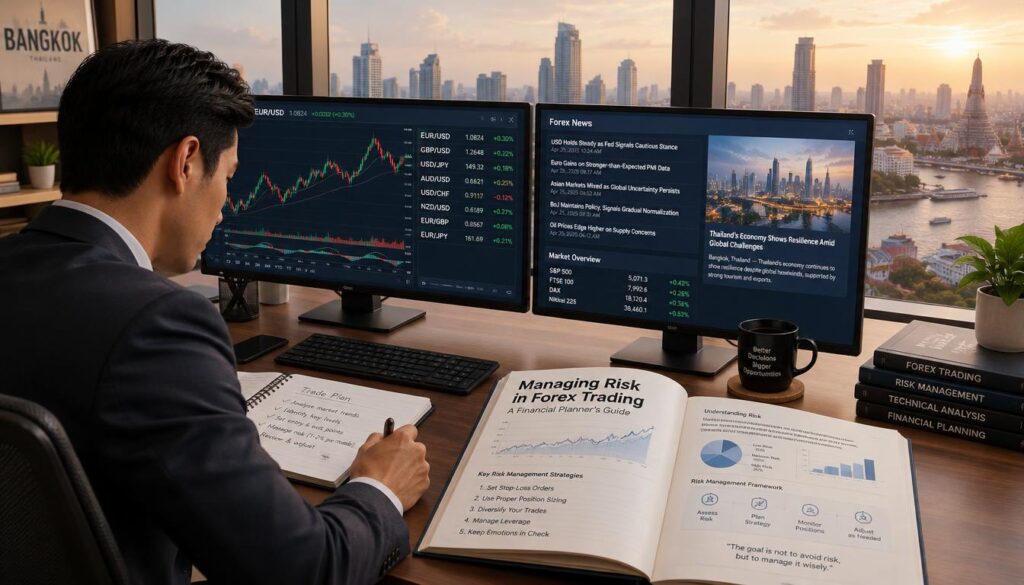
Starting the journey into currency markets requires careful planning and risk management. For Thai residents, the first step is to open and verify an account with a broker that accepts local clients. This process involves confirming identity, residence eligibility, and the broker’s regulatory compliance.
Open and verify an account with a broker that accepts Thai residents
Thai traders should ensure that the broker’s legal entity aligns with local regulations. Additionally, it’s important to check the account currency and available products before making any deposits.
Practice with a demo account and set trade-size and loss limits
A demo account can be an invaluable tool. It allows users to learn about order types, platform functions, and spreads without risking real capital. Setting trade-size limits and loss thresholds helps define a trader’s risk tolerance.
Understand leverage and the risk of losing money rapidly with CFDs
Leverage can amplify gains but also losses. Disclosures indicate that between 51% and 89% of retail investor accounts incur losses. Therefore, grasping how leverage works is essential before trading currency pairs or other derivatives.
| Aspect | Details |
|---|---|
| Minimum Deposit | $5 to $100 |
| Practical Starting Range | $500 to $1,000 |
| CFD Loss Disclosure | 51% to 89% of accounts lose money |
| Market Hours | Monday 4:00 AM ICT to Saturday 4:00 AM ICT |
Choose a broker with clear rules, costs, and protections
For Thai residents, forex trading is legal, though most retail access comes through internationally regulated firms. Compare each provider’s legal entity, licenses, spreads, commissions, funding fees, platforms, instruments, and client protections.
IG’s 2026 overall award, Saxo’s potential €100,000 Danish deposit protection, and Interactive Brokers’ Trust Score of 99 show distinct strengths, not guarantees. Terms depend on the account entity and eligibility.
Thai traders should check the Securities and Exchange Commission register, Bank of Thailand transfer rules, and offshore entity before funding an account. A demo account, conservative leverage, written loss limits, and qualified tax advice can reduce avoidable risks.
The best choice is the provider whose costs, rules, platform, market access, and safeguards fit each investor’s needs. Forex trading carries substantial risk, especially with CFDs and leverage; no broker removes that risk.