The United Kingdom stands as a major global center for currency trading. Its deep liquidity and strong regulatory framework attract many participants.
This guide focuses on FCA-regulated forex brokers that meet high standards for security and performance. Choosing a broker authorized by the Financial Conduct Authority is crucial for safety.
Independent research teams, like the one led by Steven Hatzakis at ForexBrokers.com, perform detailed analysis. They collect data across more than 100 different variables.
Their work includes tracking over 100 international regulatory agencies. This powers a proprietary Trust Score rating system to help assess reliability.
This article provides detailed reviews and practical guidance. It serves both new traders and experienced individuals looking for better features.
Understanding the U.K. Forex Trading Landscape
The British capital’s trading ecosystem offers unique advantages for market participants. London stands among the world’s primary currency hubs alongside New York and Tokyo.
This position creates exceptional market liquidity that benefits all participants. Traders access tighter spreads and faster execution during peak hours.
Market Trends and Liquidity Insights
Deep liquidity pools enable reduced slippage compared to less active markets. The London session’s overlap with European and American hours creates optimal trading conditions.
Recent trends show growing adoption of mobile platforms and algorithmic tools. Multi-asset accounts combining currency trading with CFDs on stocks and indices are increasingly popular.
Regulatory Environment Overview
Britain’s oversight framework evolved significantly with the Financial Conduct Authority’s creation in 2013. This replaced the former Financial Services Authority with more comprehensive protection.
The mature ecosystem includes transparent pricing requirements and clear complaint processes. Both retail and professional participants operate within this structured environment.
Understanding this landscape helps traders recognize why broker selection matters. Strong regulation combined with competitive conditions creates cost-effective opportunities for successful currency trading.
The Importance of FCA Regulation for U.K. Brokers
Operating with a broker regulated by the Financial Conduct Authority provides traders with essential safeguards. This regulatory body supervises retail trading activities across the country.
The Financial Conduct Authority sets comprehensive rules covering authorization, financial reporting, and consumer protection. Only firms properly authorized by this conduct authority can legally offer services to residents.
FCA Guidelines and Trader Protection
Traders can verify a firm’s authorization status using the FCA’s public register. This transparency helps identify legitimate operations.
The regulatory framework includes mandatory negative balance protection. This ensures accounts cannot fall below zero during market volatility.
UK participants benefit from the Financial Services Compensation Scheme. This provides up to £85,000 coverage if a regulated FCA broker becomes insolvent.
The financial conduct standards also grant access to the Financial Ombudsman Service. This independent body resolves disputes without costly legal proceedings.
Regular audits and capital requirements maintain market integrity. These measures create confidence that firms operate to international standards.
Navigating the Buyer’s Guide: What to Look For
A comprehensive approach to choosing a financial services provider involves examining both regulatory compliance and practical features. Traders should move beyond surface-level comparisons to assess what truly distinguishes quality operators.
Regulatory authorization serves as the foundation for selection. Traders must verify FCA registration before considering any other factors. Then they can evaluate trading costs like spreads and overnight charges.
Platform technology represents another critical consideration. Users spend significant time with these tools for analysis and execution. The range of tradable instruments also varies widely between providers.
Customer support availability during peak hours requires assessment. Educational resources and research tools differ dramatically among companies. Account funding options and withdrawal processes affect convenience.
This guide helps develop a personalized evaluation framework. Traders can identify the best forex brokers matching their individual requirements. The right forex broker combines security with functionality for optimal trading conditions.
Key Features of Top Forex Trading Platforms

Contemporary trading environments offer sophisticated tools that empower traders with comprehensive market access. Leading providers develop platforms with distinct strengths catering to different trading styles and experience levels.
User Interface and Functionality
Effective platform design balances advanced capabilities with intuitive navigation. IG’s web-based solution provides fast charting and integrated risk management tools.
Interactive Brokers’ Trader Workstation supports detailed analysis through customizable layouts. Saxo’s platform suite emphasizes clarity with responsive charts and cohesive module integration.
CMC Markets’ Next Generation platform features pattern recognition alongside Reuters news feeds. XTB’s xStation 5 incorporates sentiment data and heat maps within an accessible interface.
Multi-Device Compatibility
Modern trading platforms maintain consistent performance across devices. Synchronized data ensures seamless transitions between desktop, web, and mobile applications.
Traders can monitor positions and execute orders from smartphones with full functionality. This flexibility supports active management regardless of location or device preference.
Advanced mobile applications now offer nearly complete feature sets matching their desktop counterparts. The evolution of these trading platforms continues to enhance accessibility for all participants.
Comparing Trading Costs and Spreads
Spread comparisons reveal significant differences between various market participants. Trading expenses directly impact profitability over hundreds of transactions.
Financial intermediaries employ diverse pricing models. Some use spread-only accounts while others combine tighter spreads with separate commissions.
Interactive Brokers offers EUR/USD spreads around 0.59 pips with $2 minimum commissions. IG’s standard account averages 0.9 pips, while their DMA route reduces costs to approximately 0.75 pips.
Saxo provides tiered pricing where higher balances unlock better rates. CMC Markets maintains competitive spreads with additional commission-based options for active traders.
The most cost-effective choice depends on individual trading patterns. Scalpers need tight spreads while position traders should consider overnight financing charges.
Risk Management and Protection in Forex Trading

Understanding the statistical reality that most retail investor accounts lose money is the first step toward developing protective strategies. Broker disclosures consistently show that between 51% and 89% of retail investor accounts lose money when trading CFDs.
UK regulations provide essential safeguards for participants. FCA-regulated intermediaries must offer negative balance protection, ensuring accounts cannot fall below zero. They also display prominent warnings about the high risk of losing money rapidly due to leverage.
Effective tools help mitigate the risk losing money. Stop-loss orders automatically close positions at predetermined levels, preventing small losses from escalating. Many platforms offer guaranteed stops that execute regardless of market gaps.
Professional traders typically limit exposure to 1-2% of capital per trade. This disciplined approach helps investor accounts survive inevitable losing streaks. Emotional decision-making often causes accounts lose money more than flawed analysis.
The high risk environment demands both technical knowledge and psychological discipline. Traders should assess whether they understand CFD mechanisms before committing capital. Protecting existing funds matters more than chasing profits for sustainable participation.
Educational Resources and Research Tools Offered by Brokers
The educational resources available through currency trading platforms vary dramatically in quality and scope. Leading providers develop comprehensive learning ecosystems to support traders at different experience levels.
IG Academy and In-House Market Analysis
IG Academy represents the gold standard for broker education with its award-winning platform. It features structured courses, interactive lessons, and a dedicated mobile learning app.
The academy guides users from basic concepts to advanced strategies. This progressive approach helps build foundational knowledge before risking capital.
Quality research tools integrate multiple data sources for comprehensive market analysis. These include Reuters headlines, Autochartist signals, and proprietary commentary from in-house teams.
Daily market analysis helps traders understand current trends and identify opportunities. FOREX.com offers Trading Central modules alongside an expanding video library.
CMC Markets provides written analysis, videos, and its OPTO content hub. XTB delivers 200+ Trading Academy lessons with regular market updates.
Saxo’s thorough research combines third-party news with integrated trading signals. These comprehensive learning ecosystems distinguish top-tier providers in the industry.
Platform Experience: Desktop, Web, and Mobile
A trader’s experience with their chosen software depends heavily on how it performs across different devices. Consistency is key for executing strategies whether at a desk or on the move.
Desktop versions typically provide the most powerful tools. They support advanced charting, multiple monitors, and complex order types that serious analysts need.
Web-based trading platforms offer full accessibility through a standard browser. This eliminates software installation, ideal for those using multiple computers.
Mobile applications have evolved into sophisticated tools. They now feature advanced charting, technical indicators, and real-time news, offering near parity with desktop versions.
Cross-platform synchronization ensures watchlists and settings remain consistent. This allows for seamless transitions from desktop analysis to mobile order execution.
Our testing uses current-generation Apple and Android devices with the latest operating systems. This hands-on evaluation reflects the real-world performance a user will experience.
Performance stability can vary between a provider’s different applications. Some maintain fast execution on all devices, while others may show slower performance on mobile or web versions compared to the desktop trading platform.
The Role of Leverage and Commission Structures
The interplay between borrowed capital and transaction fees creates distinct cost profiles for different trading approaches. Leverage enables control of larger positions with smaller capital amounts, amplifying both profits and losses equally.
FCA regulations protect retail participants with strict leverage limits. Major currency pairs have 30:1 caps while minor pairs are limited to 20:1. These restrictions help prevent excessive risk exposure.
Professional classification unlocks higher leverage up to 400:1 for qualified traders. This requires meeting specific experience, volume, and capital requirements. The increased leverage comes with correspondingly higher risk.
Traders must honestly assess whether they can afford to take high risk. Complex instruments come with inherent dangers that can lead to losing money rapidly due to leverage. Margin calls can force position closures during volatility.
Commission structures significantly impact total costs. Some providers charge per-trade fees that make small positions expensive. Others offer tighter spreads that benefit larger trades and high-volume strategies.
Money trading CFDs involves careful position sizing to maintain adequate margin buffers. Understanding commission models helps traders choose cost-effective approaches matching their individual strategies and risk tolerance.
Expert Reviews and In-Depth Broker Analysis

Independent testing methodologies provide valuable insights into currency trading providers. Analysis teams evaluate more than 100 different variables during comprehensive assessments.
These reviews involve opening personal accounts and testing platforms across multiple devices. Researchers verify regulatory status and measure execution quality during various market conditions.
IG achieves the highest overall rating of 4.8 for 2025. The company delivers a cohesive trading experience with reliable execution and deep market coverage.
Interactive Brokers stands out for professional traders with its institutional-grade environment. The platform offers access to 150 market centers across 34 countries with highly competitive spreads.
CMC Markets excels with its proprietary Next Generation platform. This solution provides a polished, data-rich trading environment featuring strong charting tools.
Expert reviews examine real-world performance beyond advertised features. They assess order execution speed, platform stability, and customer support responsiveness.
The top-rated providers consistently deliver reliable performance across all evaluation criteria. This creates well-rounded trading experiences serving diverse needs and experience levels.
Evaluating the Best Forex Brokers UK Options
Systematic evaluation of trading service providers requires careful analysis across multiple dimensions to identify optimal choices. Traders should examine regulatory compliance, pricing structures, platform technology, and customer support quality simultaneously.
Comprehensive comparison tables enable side-by-side assessment of critical factors. These include FCA authorization status, average spreads on major pairs, and minimum deposit requirements. Proper regulatory oversight remains the foundational requirement for safe participation.
Spread analysis reveals significant cost variations between providers. Some offer highly competitive pricing around 0.59 pips, while others charge 1.3-1.4 pips for the same currency pairs. Overall ratings synthesize performance across multiple evaluation categories.
Third-party validation through platforms like Trustpilot provides real-world user perspectives. This complements expert testing by revealing actual customer satisfaction levels and common experiences. Minimum deposit requirements range from £0 to £100, affecting accessibility for different traders.
The ideal choice depends on individual priorities and trading styles. Some value tight spreads, while others prioritize educational resources or mobile platform experiences. Balancing multiple factors leads to the most suitable selection for long-term success.
Customer Support and Account Funding Options

Accessible customer support and flexible funding options are essential components of a quality trading service. These elements directly impact user experience and operational efficiency.
Leading forex brokers provide multiple assistance channels to meet diverse needs. Live chat offers immediate help for urgent matters during active sessions.
Phone support handles complex issues requiring detailed discussion. Email serves for non-urgent inquiries needing documentation. Many brokers offer extended availability to accommodate global clients.
Funding Methods and Deposit Requirements
Account funding convenience varies significantly between providers. Minimum deposits range from £0 to £100 among major platforms.
Popular payment methods include bank transfers, debit cards, and e-wallets. Each option balances security, speed, and convenience differently. Some forex brokers absorb transaction costs for certain payment types.
Withdrawal processing times depend on the chosen method. E-wallets often provide same-day access while bank transfers take longer. Understanding these details helps traders manage cash flow effectively during forex trading activities.
The right forex broker combines responsive support with straightforward funding processes. These services should complement rather than complicate the trading experience. Many platforms now brokers offer fee-free options above minimum thresholds.
Advanced Tools for Professional Forex Traders
Professional currency traders require sophisticated tools that go beyond basic charting and order execution. These advanced features enable complex strategy implementation and detailed market analysis.
Interactive Brokers leads in professional tool availability through its Trader Workstation platform. The system offers extensive API access for custom trading applications and automated order routing.
Algorithmic Trading and Custom Analytics
Algorithmic capabilities allow experienced market participants to automate strategy execution based on predefined rules. This removes emotional decision-making while enabling precise implementation across multiple currency pairs.
CMC Markets provides advanced pattern recognition through ProRealTime integration. The system automatically identifies technical formations and generates trading signals using sophisticated algorithms.
Direct market access connects traders directly to interbank liquidity providers. This approach bypasses dealer intervention for faster execution and better pricing transparency.
Custom analytics tools enable professional forex traders to build proprietary indicators and backtest strategies. These advanced trading platforms support optimization before risking capital in live markets.
The most sophisticated trading platforms aggregate quotes from multiple liquidity sources. Interactive Brokers provides depth-of-market visibility from 17 major interbank dealers.
Advanced order types give professional forex traders precise control over execution. CMC Markets maintains this functionality across desktop and mobile environments for consistent professional-grade analysis.
Utilizing Comparative Tables and Trust Scores
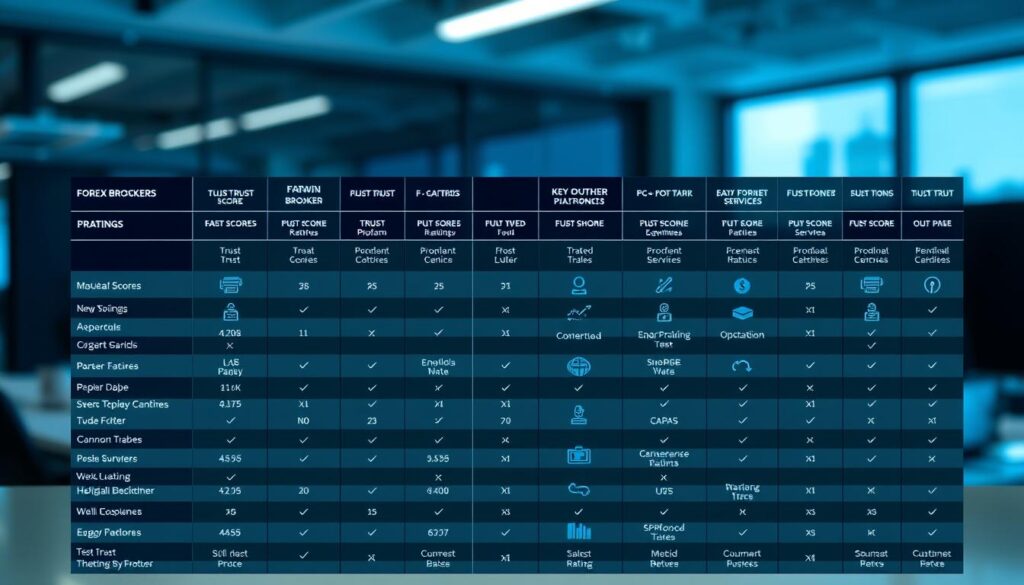
Comparison tables and trust scores transform complex provider data into clear decision-making tools. They present critical information in standardized formats for quick side-by-side analysis.
Trust Score systems offer objective assessment. Services like ForexBrokers.com use proprietary algorithms that track over 100 international regulatory agencies.
This creates a reliable measure of oversight strength. Data collection across more than 100 variables ensures analysis goes beyond superficial marketing claims.
These tables highlight key metrics like FCA authorization status. They also show average EUR/USD spreads and trading platform availability, including MetaTrader support.
Overall ratings simplify initial screening. Third-party validation from Trustpilot provides real-world user perspectives on satisfaction and common experiences.
This systematic approach helps traders identify a suitable forex broker. It balances regulatory safety with practical features for a confident selection.
Starting Your Forex Trading Journey in the U.K.
New market entrants must navigate specific requirements when beginning their trading activities. The process starts with verifying Financial Conduct Authority authorization through the official register.
Understanding regulatory rules is essential before account opening. Retail participants face leverage limits and benefit from negative balance protection.
The Financial Services Compensation Scheme provides crucial safety for deposited funds. This coverage extends up to £85,000 per eligible client.
Account setup involves identity verification and funding through approved methods. Demo accounts offer risk-free practice before live market engagement.
Tax considerations are important for successful money trading. Participants must pay tax on profits exceeding capital gains allowances.
Consulting qualified accountants ensures proper compliance with tax forex trading obligations. Different instruments have varying tax treatments under HMRC rules.
Retail investor accounts should carefully consider whether they understand leveraged products. Developing a structured approach helps manage the substantial risks involved.
Success in trading forex requires education about analysis techniques and risk management. Realistic expectations about profitability timelines support sustainable participation.
Final Thoughts on Choosing Your Ideal Forex Broker
Ultimately, the most suitable trading platform emerges from aligning provider capabilities with individual trading objectives. Different experience levels require distinct features from their chosen service.
Thorough research provides valuable guidance for this selection process. Experts like Steven Hatzakis bring decades of market experience to their analysis. Personal testing through demo accounts remains essential before committing funds.
Long-term success depends more on disciplined risk management than finding the absolute tightest spreads. Most retail accounts lose money, making education and psychological resilience crucial components.
FCA regulation forms the necessary foundation for any quality forex broker. Regular evaluation ensures your provider continues meeting evolving needs as your skills develop.